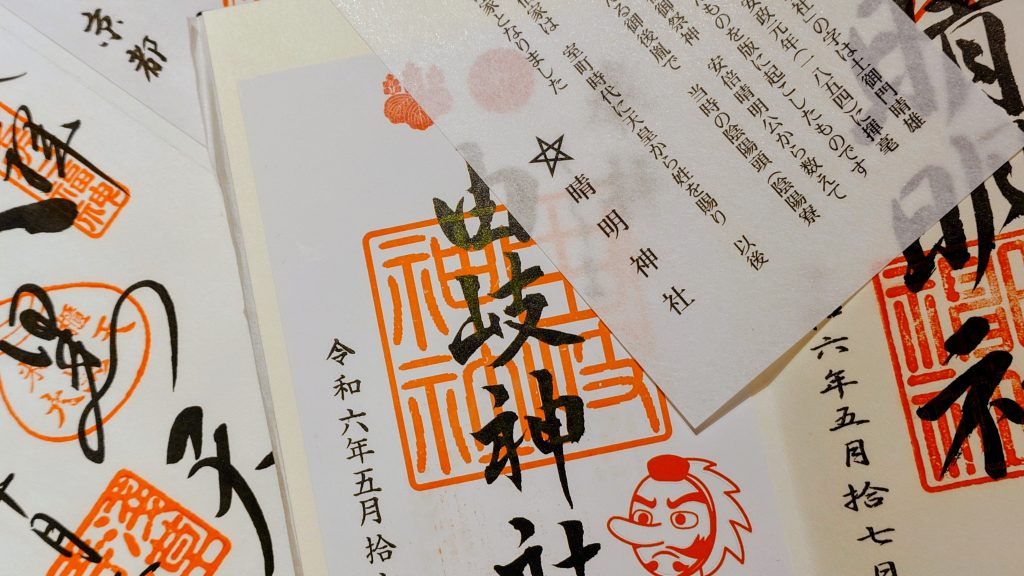
If possible, whenever I am on my travels, I like to try and visit places of religious veneration. It is probably just psychological, but I find that there is often something calming and energising in the air of these places. Even visiting ancient, long disused places of worship like the Parthenon in Athens has a different feel about the air. When I travel around Japan, I like to visit the very numerous shrines and temples dotted around. Sometimes, they can be little pockets of calmness in the middle of a busy city. For me, a part of the journey to visit the shrines and temples of Japan is obtaining a goshuin [御朱印] for my goshuincho [御朱印帳].
The goshuin is a stamp given to worshippers and visitors to some shrines and temples in Japan. These stamps are typically collected in a book called the goshuincho. As your goshuincho gets filled with more and more goshuin collected from different shrines and temples, it becomes a personal record of your spiritual journey through Japan.
How to start a goshuin collection
Japan has a strong commemorative stamp culture. Stamps from train stations, shops, and tourist attractions can be stamped in a simple notebook, or even loose pieces of paper which you have with you. However, goshuin should only be collected in a goshuincho, a special concertina-fold book. Most shrines and temples that offer a goshuin will likely have goshuincho for sale. Even some tourist attractions will sell their own branded goshuincho.

I personally have two goshuincho: one for goshuin from Shinto Shrines and the other for goshuin from Buddhist Temples. Some people say it does not matter, but I have also seen some people say that some shrines or temples may refuse to provide a goshuin if a goshuincho mixes goshuin from both Shinto Shrines and Buddhist Temples. I have personally experienced one shrine looking through my previous goshuin stamps in the goshuincho I handed to them, although I cannot necessarily confirm whether it was to check for goshuin from non-Shinto Shrines.
Receiving a goshuin
Not all shrines or temples offer goshuin stamps, but a lot do. I have set up an interactive map below showing which shrines and temples I have received a goshuin from. I have separated the entries into two categories: one for Shinto Shrines and one for Buddhist Temples.
Shrines and temples that offer goshuin will have a “goshuin reception”. The Japanese Kanji you should look out for are 御朱印所, 授与所 or 社務所. The first literally means “goshuin office”. The second literally means “conferring / granting office”. The third literally means “shrine service office”. I have seen some commentators say that the first is usually found in Buddhist Temples, whereas the second and third are usually found at Shinto Shrines. However, I have seen 御朱印所 or 朱印所 [without the 御 honorific] at Shinto Shrines too. For example, the Kamado Shrine in Fukuoka, where many Demon Slayer fans make a pilgrimage to, uses 御朱印所.
Visit the “goshuin reception” after you have prayed or paid your respects. Usually, shrines and temples will charge around ¥300 to ¥500 for a goshuin stamp. Make sure you have cash available as I have only seen cash being accepted as payment in exchange for receiving a goshuin stamp.
Not all shrines and temples will offer a goshuin which is written directly into your goshuincho. Some will offer pre-written goshuin on a separate piece of paper which you can then stick into your goshuincho afterwards. These are called kakioki goshuin [書き置き御朱印] in Japanese.
When you go to the “goshuin reception”, I would recommend opening your goshuincho to the page where you want the goshuin. You may want to have the handwritten goshuin on a certain page to leave space for some of the kakioki goshuin you may have received but not yet stuck into your goshuincho.
What is written on a goshuin?

As someone who still enjoys writing with traditional brush pens, collecting goshuin stamps is also a way to have a nice collection of traditional brush pen calligraphy. But what does it all say? Let us use the kakioki goshuin from Tokyo Tower above as an example.
On the right [traditionally, vertical writing is read from right to left], 奉拝 means worship. It is to signify that you have been to that particular shrine or temple for worship.
In the middle, the name of the shrine is written in calligraphy. In this case, タワー大神宮 [Tower Daijingu], translated as the “Tower Great Shrine”. Goshuin from temples will sometimes give the name of the deity that the temple is dedicated to. For example, the Sensoji [浅草寺] in Asakusa has Goshuin which feature the names Daikokuten [大黒天] or Shokanzeon [聖観世音].

On the left, 令和七年十月十九日 is the date for the goshuin. In Japan, the dating format is year, month, day. The year is 令和七年 [seventh year of Reiwa]. In Japan, formal dating is still done by reference to the Emperor’s reign. The seventh year of Reiwa translates to 2025 in the Gregorian Calendar. 十月 is the tenth month, so October. And 十九日 is the 19th day. Putting it all together, 令和七年十月十九日 translates to 19 October 2025.
Final thoughts
Collecting goshuin has become a quiet ritual that runs alongside my journeys through Japan. It is part travel diary, part spiritual record, and part appreciation of traditional calligraphy and culture. Even if you are not religious, taking the time to step into a shrine or temple, to pause, to reflect, and to appreciate the spiritual nature of the place can be meaningful. Receiving a goshuin after you have made your own prayers or spiritual reflections can be a way of marking a moment of calm in the middle of your travels. If you decide to start a goshuincho, you may find that, over time, those pages come to tell a story of where you have been, and perhaps also of how you have changed spiritually along the way.
Even as goshuin collecting becomes better known among visitors to Japan, it is worth remembering that shrines and temples are not tourist attractions, but, first and foremost, living places of worship. Going quietly, behaving respectfully, and following local customs is one of the most important things you can do to respect and honour the local people for whom these spaces are part of everyday spiritual life.