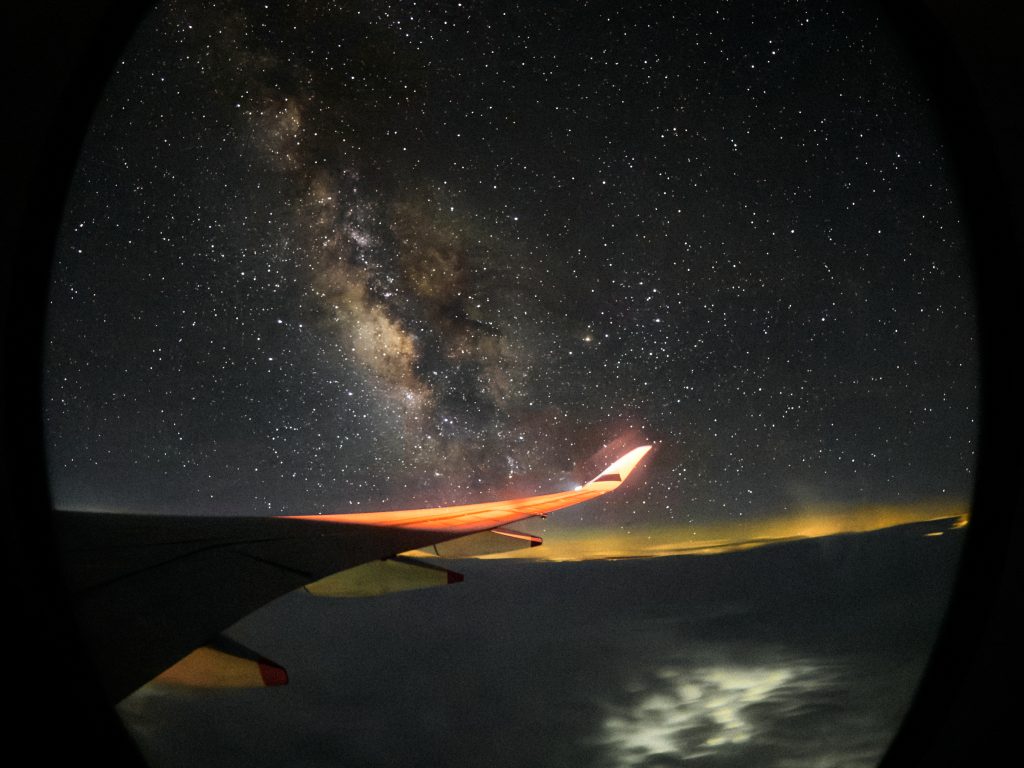
OM System OM-1 Mark II, OM System 8 mm f/1.8 Fisheye Pro.
ISO 25600, 2 seconds, f/1.8.
There is one thing which has always fascinated me about the night sky. It is something that seems easy to know but hard to feel, or even understand. Every time you look up, you are not looking at the sky as it is. You are looking at the sky as it was in the past.
Moonlight is a little over a second old. Sunlight is a little over eight minutes old. This means if the sun dematerialised, we would only know about it eight minutes after the instance it happened. Outside of our solar system, the numbers become awe-inspiring and humbling at the same time to me. The nearest star beyond our own, Proxima Centauri, is a little over four years away, as light travels. Most of the stars we can actually see with the naked eye are as they were decades or centuries ago. Look at the core of the Milky Way, and you are looking at light that set out before recorded history.
No light that reaches our eyes is ever describing the present. It is always describing the past. Even the light reflecting off the wingtip of the A350 in the picture above is as it was in the past, even if that past is only nanoseconds ago.
I wrote about this feeling in Brief Reflections on the Sky at Night, after being in a Norwegian dark sky area. I had grown up, like most people now do, under skies bright enough to erase all but the boldest constellations. Over 80 per cent of the world’s population lives under light-polluted skies. In Europe and North America that figure is closer to 99 per cent. The first time I stood somewhere properly dark, familiar constellations were lost among the many more stars now visible. Deneb’s light was 1,411 years old by the time it reached me. Polaris’s was 432. That kind of fact can make one feel pleasantly small.
Flying at 30,000+ feet, above the haze of light pollution, the sky becomes dark enough to catch the galaxy’s core. I used the opportunity to snap a photo of the Milky Way — the photograph at the top of this piece. If you would like the story of how it very nearly did not come out at all, have a read of Photographing the Milky Way from 37,000 ft. What I did not get into in that post is what happened after I landed: I started looking up the individual stars in the frame, one by one, and working out exactly how old their light was. Then I started matching those numbers to dates. What was happening on Earth when this particular light set out. It turned out to be one of the more reflective things I have done with a photograph, and it is the reason for this post.
Long before anyone could put a number of years on a star’s light, people were already reading the sky as a kind of text. The Greeks saw hunters and bears and the vain queen Cassiopeia, tied to her chair.
In Aboriginal Australian traditions, some of the oldest continuous storytelling on Earth, the dust lanes of the Milky Way trace the shape of an emu, and its position through the year told people when to gather emu eggs. Across the Pacific, wayfinders memorised the rising and setting points of specific stars along the horizon and used them, without instruments, to navigate open ocean between islands separated by thousands of miles.
Chinese astronomers were recording precise observations of “guest stars” — what we would now call novae and supernovae — a thousand years before the invention of the telescope. None of these traditions had the concept of light-years. All of them, in their own way, understood that the sky was not simply decorative. It was old, it was patterned, and it mattered.
I find that continuity more moving than the numbers alone. We have always looked up and tried to make the vastness mean something, because the alternative — looking up and feeling nothing — seems to be something humanity has never really managed. Even now, with the actual figures available to us, a light-year is not really a distance I can picture. It is about 5.9 trillion miles. Multiply that by hundreds, or thousands, or tens of thousands, and it stops being a number I can hold and it becomes something closer to a feeling: the sense of being very small, for a very short time, in something very old.
That is the feeling I want to spend some time examining with you all in a series of posts. The photograph above holds 18 individual points of light I specifically identified. The light from each of those stars left its source at a specific, dateable moment. I want to work through all 18 from the most recent light to the oldest. In doing so, setting each one against whatever else was happening on this small, comparatively very young planet at the time to put the grand scale of the cosmos into the context of humanity’s own existence.
It started, if I am honest, as an Instagram carousel — a format that rewards brevity, not dwelling. This is the version where I get to dwell.