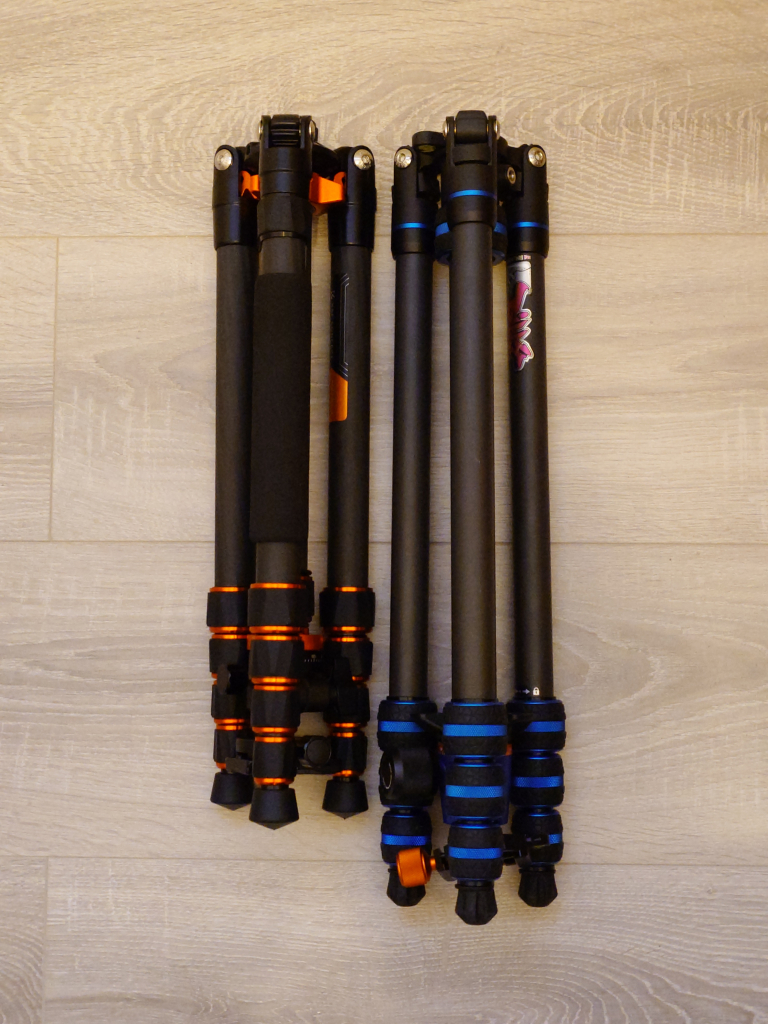
My first trip to Finnish Lapland claimed my previous tripod with temperatures of around -20°C. After I came back to the UK, I bought myself a Billy 2.0 tripod from British brand 3 Legged Thing. I have been using my Billy 2.0 ever since, and it has accompanied me on all of my Arctic trips. My other half uses the K&F 68″ carbon fibre tripod when we are photographing the Milky Way or the aurora. Since we had both tripods during a trip to Yellowknife, I thought I would see how they behave in use. They are pretty similar tripods so the comparison feels reasonably fair. The K&F sells for £128.99, whilst the 3 Legged Thing Billy 2.0 sells for £249.99. They’re just tripods, right? Does price really matter? I have set out some of the key specs in the table below.
| K&F 68″ carbon fibre tripod (affiliate link) | 3 Legged Thing Billy 2.0 (affiliate link) | |
| Price | £128.99 | £249.99 |
| Maximum height | 68″ / 172 cm | 65″ / 164 cm |
| Folded length | 17″ / 42 cm | 18″ / 46 cm |
| Weight | 2.2 lbs / 1.32 kg | 3.46 lbs / 1.57 kg |
| Maximum load | 22 lbs / 10 kg | 40 lbs / 18 kg |
Yellowknife, Canada
You may have noticed that I mentioned Yellowknife, but it’s been over a year since I went to Yellowknife. So why have I still not written up my findings yet? The temperature in Yellowknife was around -37°C, with the forecast saying it felt like -44°C. Sadly, both tripods did not do very well in those kinds of extremes. The K&F proved impossible to move. I suspect the lubricants and joints had simply frozen solid because I could move it again after returning indoors. I could still move the 3 Legged Thing Billy 2.0, although the ball head became rather stiff. The Billy 2.0 also ended up with a freely swinging leg. Danny Lenihan, founder of 3 Legged Thing, suspected the likely cause to be the reaction of the brass used in the mechanisms to the extreme cold.
I only noticed the freely swinging leg of my Billy 2.0 when I had finished shooting and was packing up. In that sense, the Billy 2.0 actually did a lot better than the K&F out in the extremes of -37°C. At least I could still move the ball head of the Billy 2.0 — albeit the ball head getting stiffer and stiffer the longer I was out in the elements — to recompose my shots, whereas I could not move the K&F ball head.
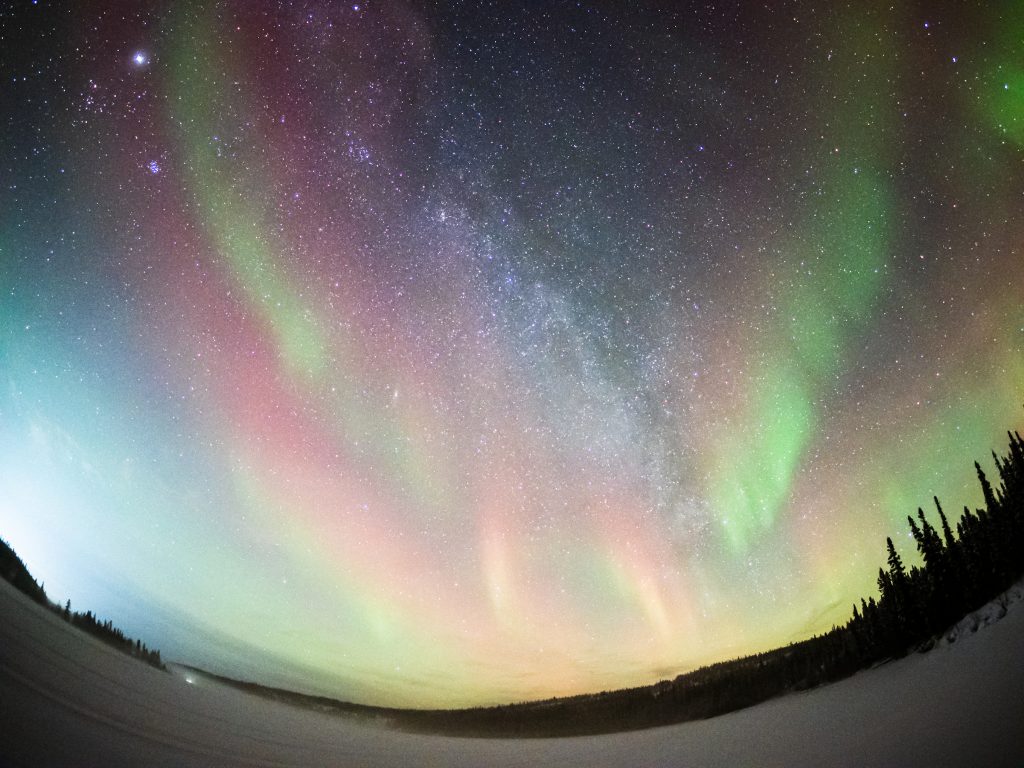
OM System OM-1 Mark II, OM System 8 mm f/1.8 Fisheye Pro.
ISO 6400, 10 seconds, f/1.8.
Swedish Lapland
When I contacted 3 Legged Thing with my findings from Yellowknife, Danny arranged for a replacement Billy 2.0 for me. Danny mentioned that 3 Legged Thing tripods are tested to -30°C, so a trip to Swedish Lapland with temperatures of around -20°C seemed like a more reasonable testing ground than the extremes of Yellowknife that I subjected the tripods to last year.
As an ethical disclaimer, although 3 Legged Thing provided me with a replacement Billy 2.0 tripod, what is written here are entirely my own views, and 3 Legged Thing have not been able to influence what is said herein.
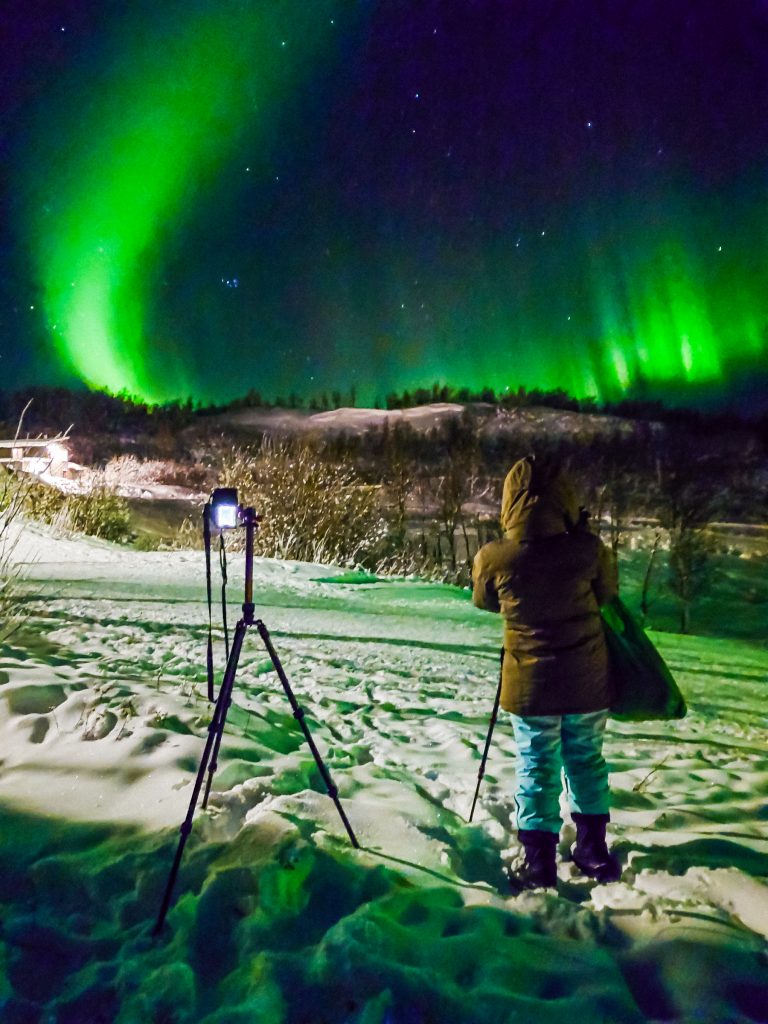
Sony Xperia 1 VI, default camera JPG.
ISO 12800, 1/3, f/1.9.
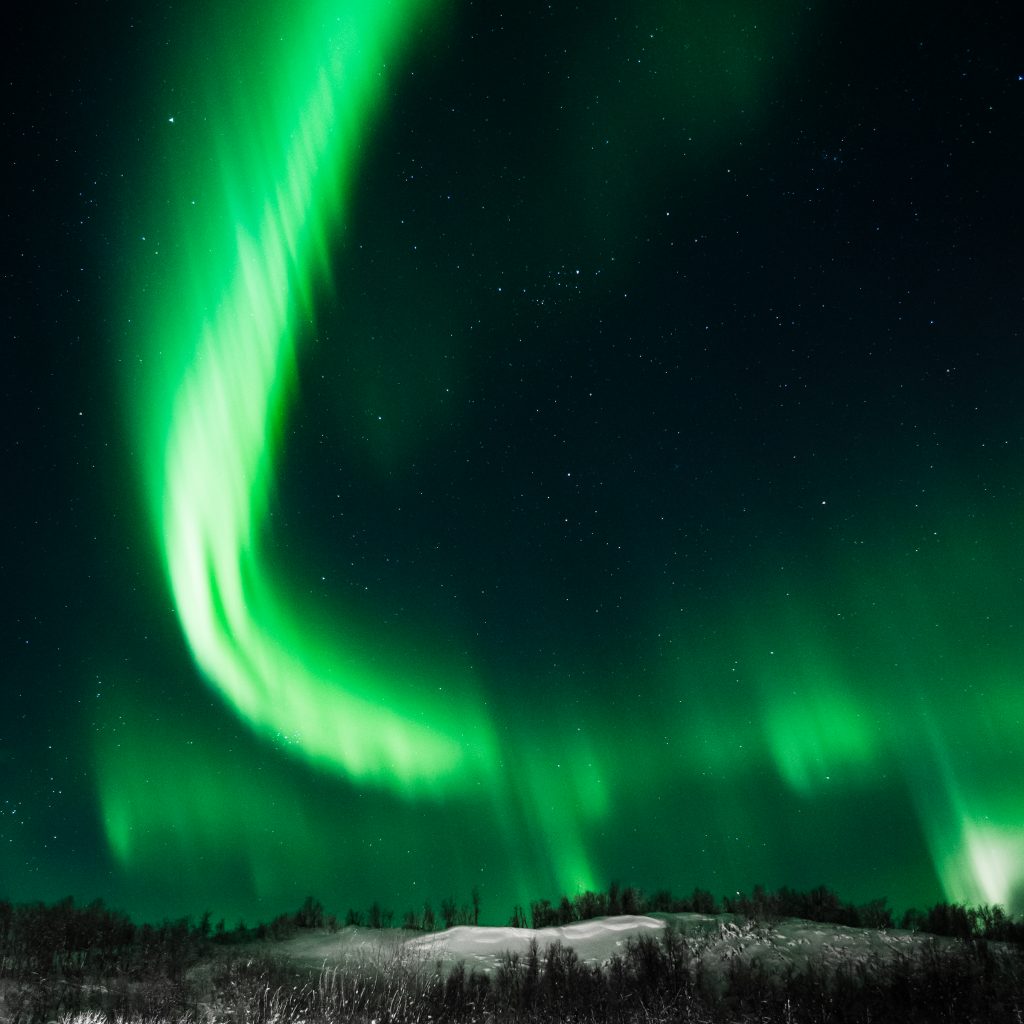
OM System OM-1 Mark II, OM System 7-14 mm f/2.8 Pro.
ISO 3200, 5 seconds, f/2.8.
Controls
Both tripods are operated in very similar ways. In terms of the ball head, they both have knobs which adjust the ball head, the lateral rotation of the whole ball head unit, and a knob to adjust the tightness of the Arca-Swiss clamp which secures the camera that is attached to an Arca-Swiss compatible baseplate like the Peak Design Capture (affiliate link) base plates. However, I prefer the bigger and bolder design of the control knobs by 3 Legged Thing, especially since this makes the tripod easier to use when shooting with gloves needed for the Arctic sub-zero temperatures.
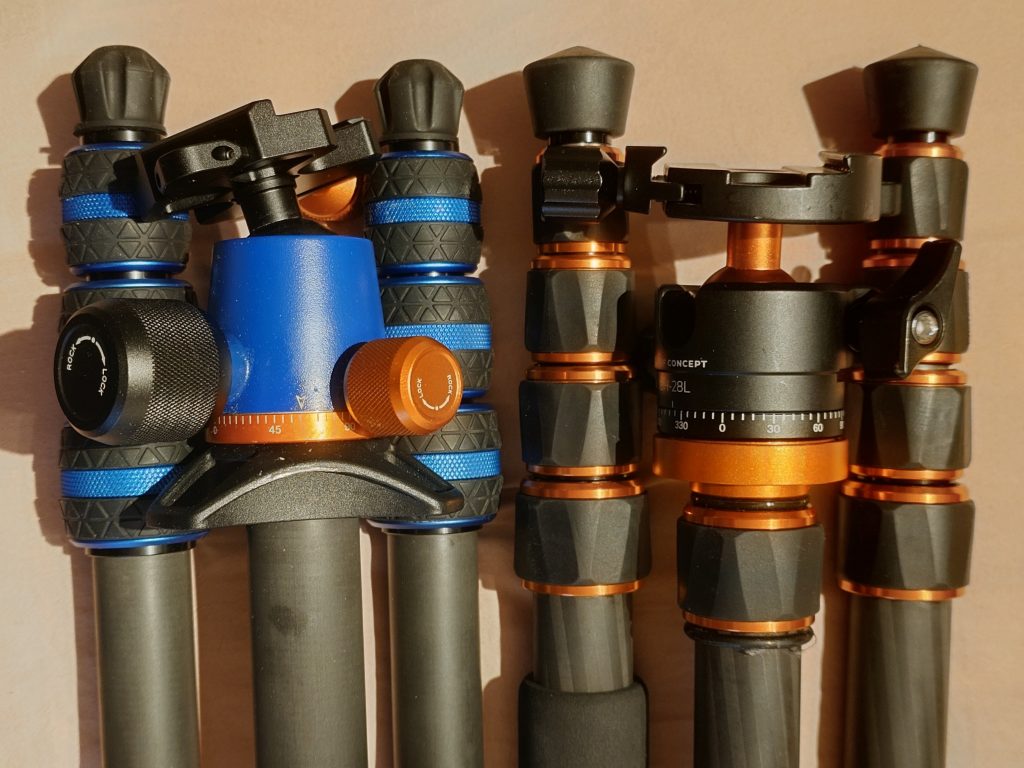
The chunkier and bolder implementation of the leg extension mechanisms of the 3 Legged Thing Billy 2.0 wins here. It’s easier to feel and use them when wearing gloves. I found the 3 Legged Thing leg mechanisms also easier to tighten than the K&F. Whilst wearing gloves, I actually had a lot of issues with the fact that the K&F leg tip is wider than the leg extension mechanism, as it meant I ended up unscrewing the tip of the leg instead. I actually lost the tip of one of the legs whilst shooting in the night. I discovered the tip was missing when I got back indoors as I couldn’t stand the tripod up properly on the flat floor — when outdoors, I was simply jamming the tripod legs into the thick snow. Thankfully, I actually found the leg tip on the path the next day.
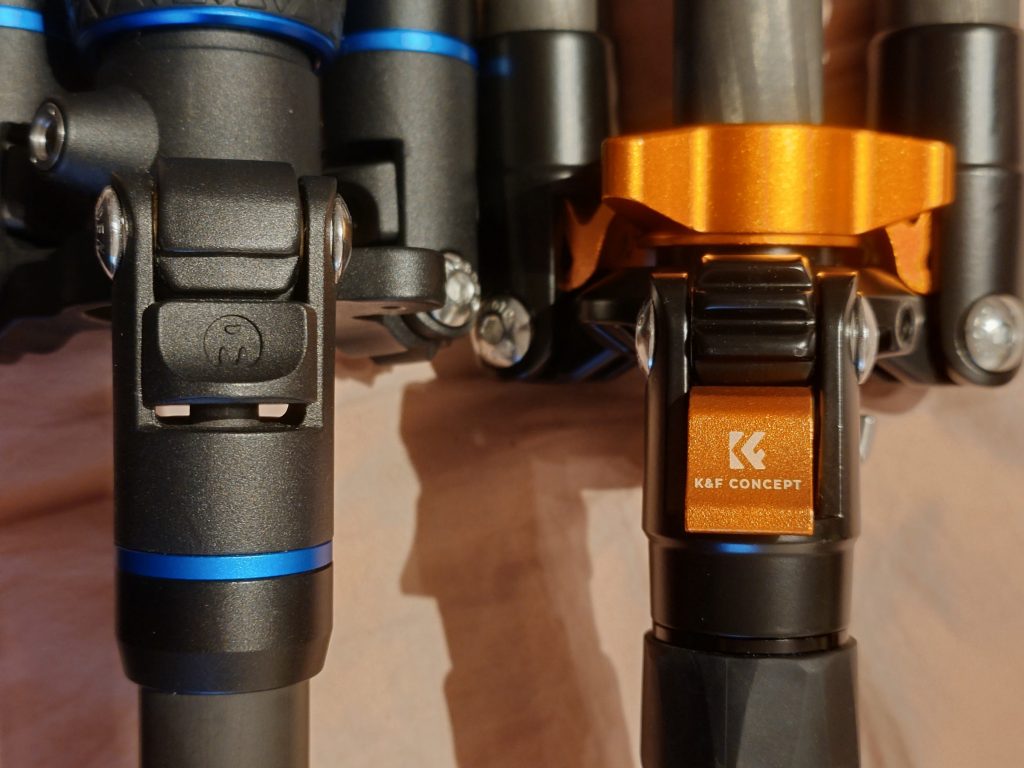
Whilst I generally prefer the way 3 Legged Thing have implemented the main mechanisms for setting up and field usage, I actually prefer the K&F locking latches for the legs as they protrude a little bit further than the 3 Legged Thing Billy 2.0, which makes it easier to fold away when wearing gloves. There is not that much difference in them, but the way the K&F does not sit as flush with the rest of the leg just makes it a little bit easier to use for my Arctic use case.
Smoothness
Even before stepping out into the cold, I already found the 3 Legged Thing Billy 2.0 a lot smoother to operate compared to the K&F. The Billy 2.0 tripod I brought with me to Sweden was a lot smoother than the copy I had in Yellowknife. It might have been that the copy I had with me in Yellowknife was already well-used, and not as well lubricated as the new copy I used in Sweden.
But there was really no contest between the Billy 2.0 and the K&F — the K&F was stiff to move around. The legs required a lot of effort to rotate, as did the ball head even after loosening the screw which held the ball head in place. When you are out in the elements, and especially when you are rushing to set up for a shot of the aurora weaving in the night sky, the ability to speedily set up is quite important, and the K&F’s stiffness definitely hampered me.
It might also be worth mentioning that I noticed a difference in the way the ball heads of the two Billy 2.0 tripods were after Yellowknife and Sweden. With temperatures at -37°C, I felt that this may have affected the lubricant more permanently as, even after bringing the tripod back indoors, the ball head was not as smooth and felt as if movement was stiff and snaggy. It was as if the distribution of the lubricant of the ball head had been affected by being out in -37°C for over an hour. I did not find the same thing happening with the copy I brought to Sweden. Even after over an hour in -20°C, I felt the ball head was still just as smooth after I brought it back indoors.
Although I did not find this to have been the case with the K&F ball head after both Yellowknife and Sweden, that added effort needed to shift the ball head on the K&F meant it was not as easy or enjoyable to use as the Billy 2.0 in the field. The ease of movement matters a lot especially when wearing gloves since dexterity is reduced, and it can feel like burning if you touched the tripod with your bare hands after it has been out in the elements for over an hour.
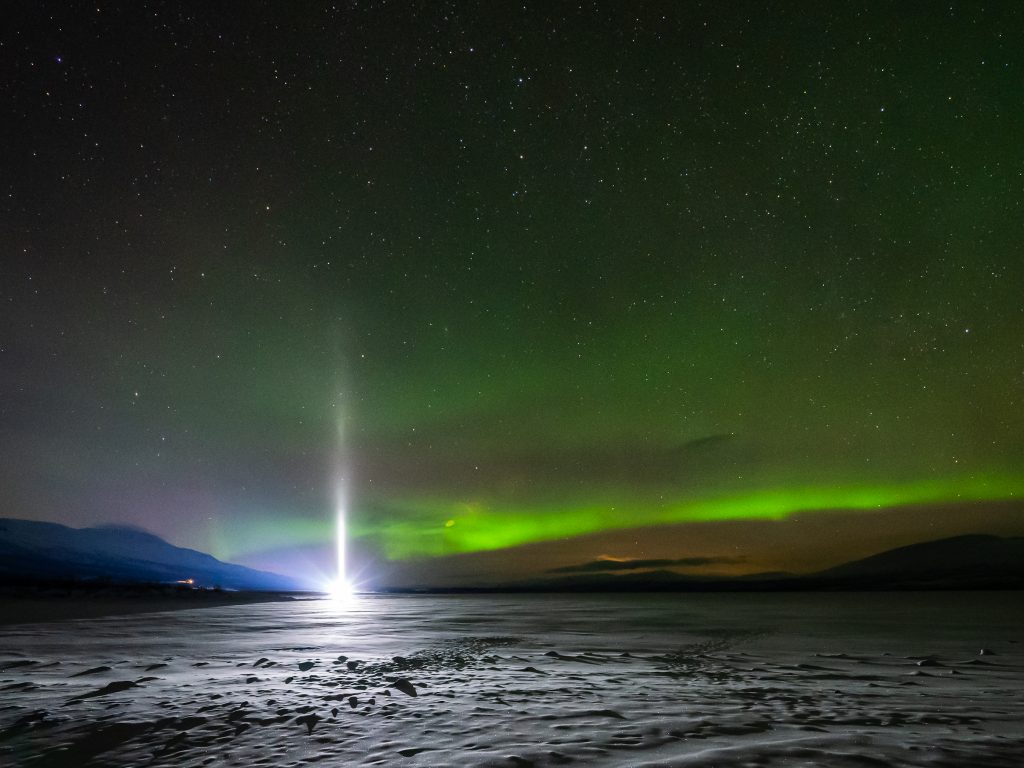
OM System OM-1 Mark II, OM System 7-14 mm f/2.8 Pro.
ISO 6400, 5 seconds, f/2.8.
Does price matter?
Does the £121 price difference between the K&F and the 3 Legged Thing tripods matter? I suppose that would depend on your priority. If you are just looking for a basic tripod to shoot static landscapes in actually survivable temperatures, and do not need to quickly set up or pack up due to ever-changing aurora and weather, then I suppose not. The K&F offers a stable base for you to shoot from. But in more demanding shooting conditions, stability alone is not enough.
Having used both the cheaper and the more expensive offerings, would I stand by my extra £121 spend for the Billy 2.0? Yes. What I feel I am paying the £121 difference for is the attention to the little details in how the basic functional mechanisms are implemented — the bigger and bolder controls which make it so much easier to use when gloved, the smoother movements, the tighter tolerances.
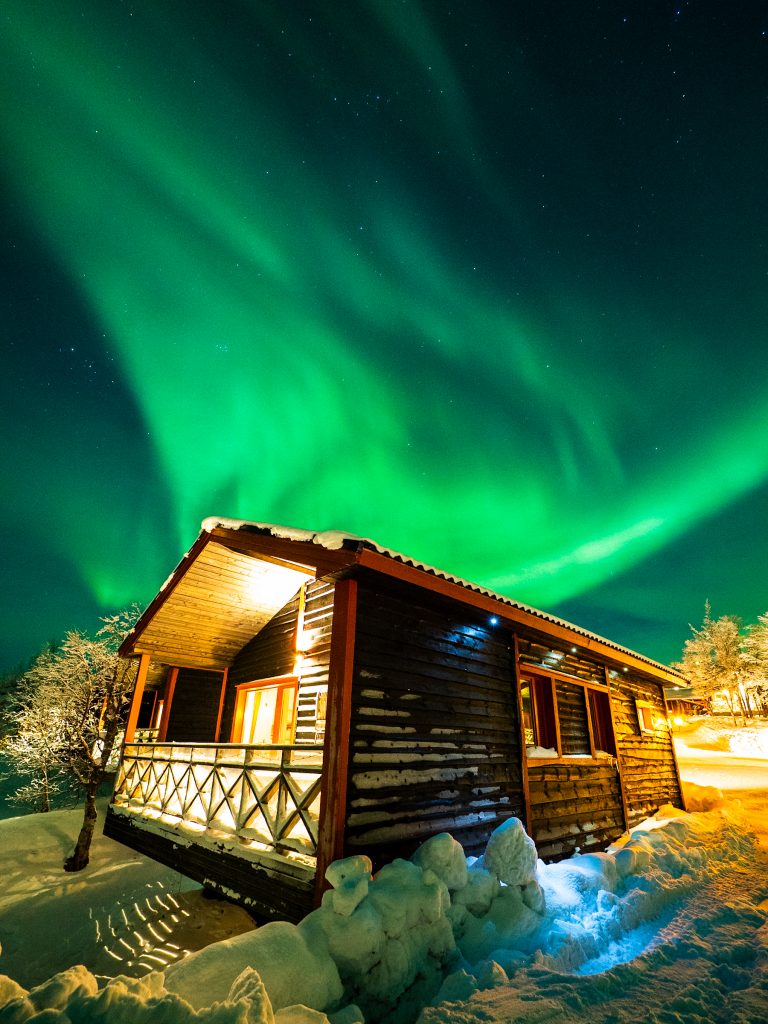
OM System OM-1 Mark II, OM System 7-14 mm f/2.8 Pro.
ISO 1600, 5 seconds, f/2.8.