OM System OM-1 Mark II, OM System 8 mm f/1.8 Fisheye Pro.
ISO 25600, 2 seconds, f/1.8.
Capture One has always been one of those editing apps which I seem to have a love-hate relationship with. I initial bought Capture One with a good discount when I bought my first Leica. I had used pretty much as my sole editing tool until they really started pushing their subscription model. One of the problems I always had with Capture One though is the quality of their denoising. It was okay for low ISO photos, but I did not like the results for ISO 3200 or above. With Capture One releasing version 16.8 earlier this week (w/c 25 May 2026) — including the new ‘enhanced denoise’ — I thought I would give Capture One another go.
The official Capture One blog introducing enhanced denoise says it should be used at ISO 3200 and above. For anything at lower ISOs, the normal denoise should suffice. So what better torture test to use for enhanced denoise than dropping into Capture One my photo of the Milky Way taken from an Airbus A350-900 flying over western Azerbaijan at 37,000 ft. I shot this at ISO 25600, a perfect torture test for Capture One’s new enhanced denoise.
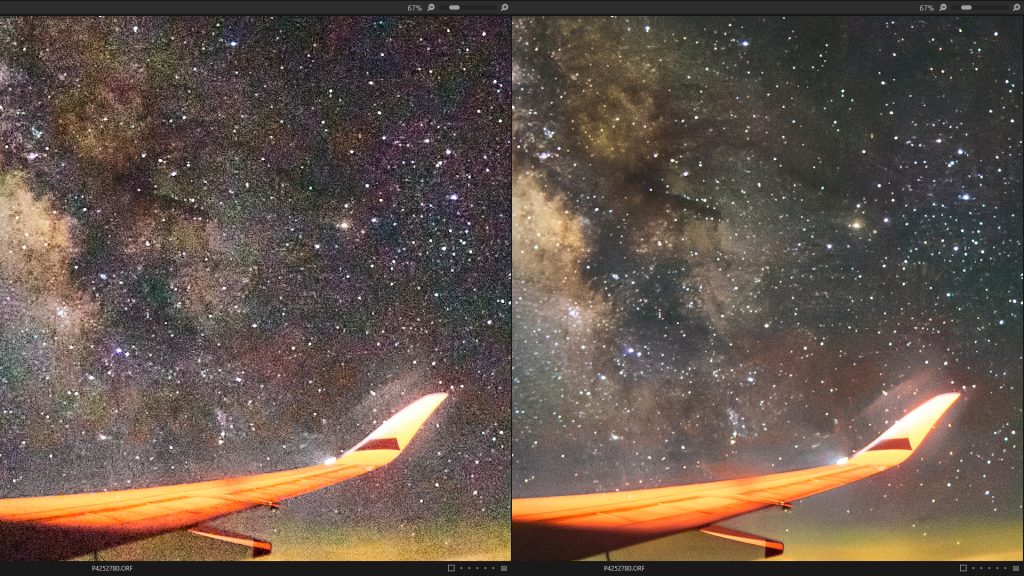
Anything I say about enhanced denoise probably won’t do it justice. It completely exceeded my expectations. I did not think that the new feature would actually create such a marked difference from Capture One’s normal denoise. The comparison below shows the amazing difference between the normal and the enhanced denoise. On the left is how Capture One’s normal denoise deals with ISO 25600, and on the right is the new enhanced denoise.


The new enhanced denoise from Capture One actually also does quite well when compared against DxO’s DeepPRIME denoise. I’ve put together a 100%-crop from DxO and Capture One for the side-by-side comparison below. On the left is DeepPRIME XD3 and on the right is Capture One’s new enhance denoise. I found that Capture One’s default enhanced denoise impact setting at 50 is a bit too high. Dialling it back down to 30 so as to not make it too overly smooth.


In terms of artefacts from denoising, both DxO and Capture One has them. They both seem to have similar amounts of denoising artefacts. I cannot really decide which rendering I like more yet though — if I had to pick one right now, I think I would say Capture One, but I think it might be a case of editing with both to figure out which I like the best. I actually find using DxO’s FilmPack to add some black and white film grain back into the image actually helps make the artefacts nearly unnoticeable. One thing to note is that I have not actually tried to pit how DxO’s FilmPack grain options compare to just using Capture One’s in-built grain option, but I suppose it should be pretty similar.
One response to “Review: Capture One Enhanced Denoise”
[…] with DeepPRIME XD3. I was even more surprised at Capture One’s new enhanced denoise feature. My last blog post covered denoising this image in a bit more […]